Printable
Skat Score Sheet
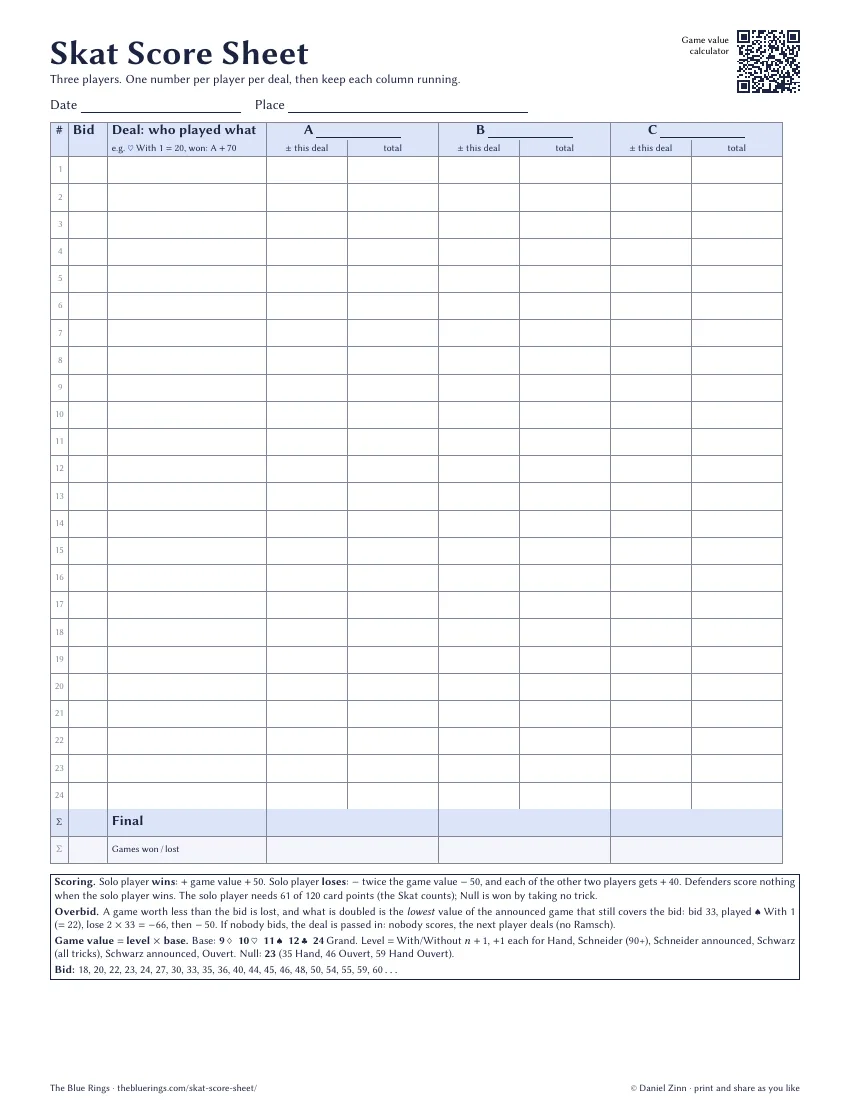
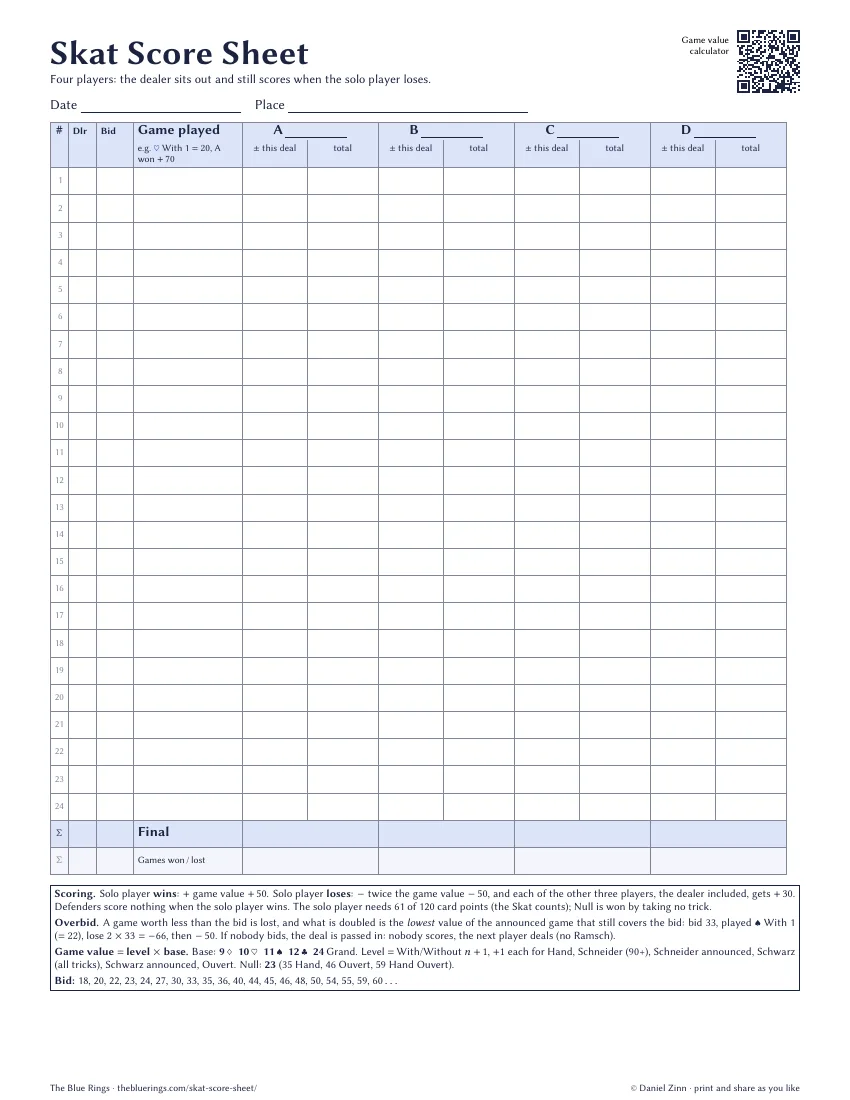
One page, a bid column, one number per player per deal and a running total, with the game values and the scoring rules printed at the bottom so you never have to look anything up. Print as many as you like and pass them around.
Need the rest on one page too? Try the cheat sheet or the game value calculator.
How to keep score
After every deal, write what was played, then one number in each player's column: what they scored that deal. Add it to their running total. Series scoring, the official way, works like this:
| Result | Solo player | Each defender |
|---|---|---|
| Solo player wins | + game value + 50 | 0 |
| Solo player loses | − 2 × game value − 50 | + 40 |
With four players the dealer sits out each deal, and when the solo player loses, each of the other three players gets 30 instead of 40.
This is the Seeger–Fabian system, the usual way to score a Skat series. A defender scores nothing on a deal the solo player wins. The official list only records the solo player's game points during the series and adds the 50s and 40s at the end, but doing it per deal gives every player exactly the same total and lets you see the standings as you go.
Three examples
- Won. A plays hearts With 1: game 2 × 10 = 20. A wins: A +70, B and C 0.
- Won with Schneider. A plays clubs With 2, wins with 90+ points: game 3, Schneider 4, 4 × 12 = 48. A +98.
- Lost, overbid. A bids 33 but plays spades With 1 = 22. The game is worth less than the bid, so it is lost. The lowest spades game covering 33 is 33 (3 × 11), so A scores −116 (−66 − 50) and B and C get +40 each.
Not sure how to work out the game value? The bottom of each sheet has the base values and the extras, and the calculator does the sum. The bid in the overbid example is also explained in bidding, explained.
Who deals, and what if nobody bids?
Draw for the first dealer and rotate to the left. If all players pass, nobody scores, the deal is passed in, and the next player deals. Tournament Skat has no Ramsch (the all-pass game some home tables play); if your table does, agree on its scoring before you start. Doubling announcements like Kontra and Re are home rules too, and are not part of the official game.
Common questions
How do you keep score in Skat?
Each deal, work out the game value (level times base value). If the solo player wins, they score the game value plus 50. If they lose, they score minus twice the game value, minus 50, and each defender scores 40. Add each player's results down their column.
What does the solo player score when they lose?
Minus twice the game value, and minus another 50 in series play. A game that is worth less than the bid is also lost, and then the loss is twice the value of the lowest game that would have covered the bid.
How do you score Skat with four players?
Play is the same as with three, but the dealer sits out each deal. When the solo player loses, each of the other three players, including the dealer who sits out, scores 30 instead of 40.
How many deals make up a game of Skat?
That is up to the table. In German tournament play (DSkV) a series at a four-player table is 48 deals, which is two of these sheets. At home most tables play a set number of deals or play until time is up. Each sheet has 24 lines, a whole number of rounds for both three and four players.
Is there a simpler way to score Skat?
Yes. Many home tables score only the game value: the solo player gets it on a win and loses twice it on a loss, with no 50-point bonuses and no points for the defenders. The sheet works for that too, just ignore the 50s and the 40s.
New to the game? Start with how to play Skat, or try the practice quizzes.