Detailed design
Why Skat's own cards fight its own rules.
The Design page covers the highlights. This is the full write-up — written in July 2020, while the deck was still just an idea — with the actual reasoning behind every decision, including the ones we tried and threw out.
The problem: a 200-year-old deck built for something else
Skat is a 3-player trick-taking game devised in Germany more than 200 years ago, and it's still one of the most popular card games in the country — declared an Intangible Cultural Heritage by UNESCO in 2016. Its biggest drawback is a steep learning curve, and a lot of that curve has nothing to do with the actual rules of the game. It comes from a mismatch between the rules and the deck everyone plays them with.
Five specific ways a standard deck actively fights Skat's own rules:
- Jacks aren't in their own suit. In suit and Grand games, Jacks are always trump — the Jack of Hearts isn't part of the Hearts suit at all. If an Ace of Hearts is led and you play the Jack of Hearts, you're not following suit, you're trumping. That's only legal if you hold no other Hearts. Confusing to explain, and confusing to be on the receiving end of as a new player.
- Point values don't match the numbers. 7, 8, and 9 are worth nothing. Unlike Blackjack, where J/Q/K are all worth 10, in Skat a Jack is worth 2, a Queen 3, a King 4. Only the 10 (10 points) and Ace (11 points) land anywhere near where you'd guess. Every other trick-taking game you've played has trained you wrong.
- The ranking for winning tricks doesn't match the point values either. In suit and Grand games the order is 7, 8, 9, Q, K, 10, Ace — the 10 outranks both the King and Queen. And within trump, every Jack outranks the Ace of the trump suit. Two completely separate things (what a card is worth, and what beats what) to keep straight, printed nowhere on the card.
- The Jacks have their own arbitrary order too. Weakest to strongest: Diamonds, Hearts, Spades, Clubs — the Jack of Clubs is the single highest-ranking card in the entire game. There's no logic to memorize here, just four specific facts.
- Null games throw out everything you just learned. No trump at all — not even the Jacks, which suddenly rejoin their printed suit. The ranking resets to 7, 8, 9, 10, J, Q, K, A, with the Jack now sitting between the 10 and Queen. A second, unrelated ranking to learn on top of the first.
None of this bothers an experienced player — it's second nature after enough games. But for someone learning, every one of these is friction that has nothing to do with actually playing Skat.
The redesign, decision by decision
The Blue Rings deck has the same 32 cards, four suits, and 1:1 mapping to a standard Skat deck as the game itself requires. What's different is the design and naming of the cards — chosen so the problems above simply don't come up.
New suits
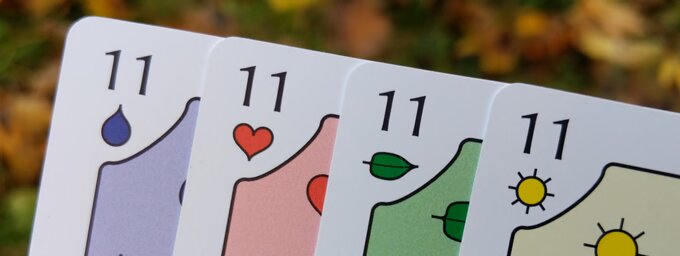
We wanted a friendly, colorful, modern look — partly to attract younger players, partly to shed any association with existing card games. Four clearly distinct colors: yellow, red, green, blue, with symbols (sun, heart, leaf, drop) chosen specifically so each suit is still recognizable printed in black and white. Red and green weren't arbitrary either — they echo the Hearts and Leaves suits in traditional German-suited decks, so the deck doesn't feel like a total break from tradition. All the suit names are one syllable except yellow, chosen for how easy they are to say out loud mid-game.
The Ring cards (what used to be Jacks)
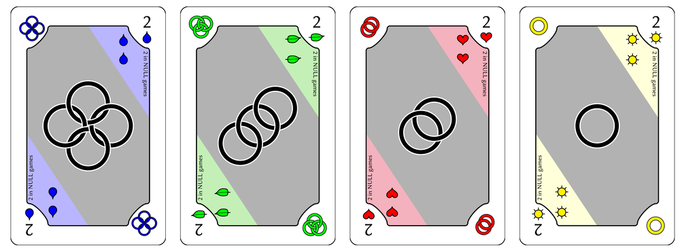
Since Jacks are semantically nothing like the rest of the deck — highest trump, not part of any suit — we gave them their own category entirely: grey, trump, and a new identity as Ring cards. The order among them is now something you can see instead of memorize: one ring, two rings, three rings, four rings, weakest to strongest. We named them "the yellow ring," "the red rings," "the green rings," "the blue rings" for the same reason — "I had the green and blue rings" is just an easier sentence than "I had the 2- and 3-rings," and it avoids ever confusing the four-ring (blue) card with being called "the 4."
New Queen, King, 10, and Ace
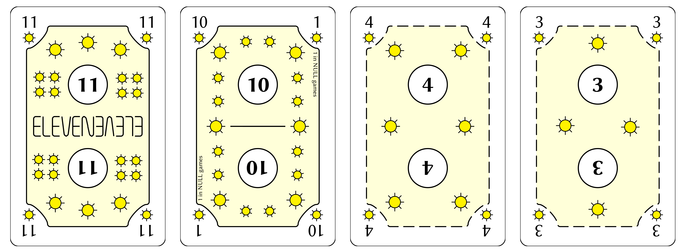
Renamed 3, 4, 10, and 11 — the printed number is the point value, and the higher number always outranks the lower one. No more remembering that a Queen is worth 3 but a King is worth 4, or that a 10 somehow outranks both of them. Three different border styles do double duty as a ranking cue too: a thin border for the zero cards, a dashed border for the mid-value cards, a thick border for the 10, 11, and Ring cards.
New 7, 8, and 9 — and the design we threw out
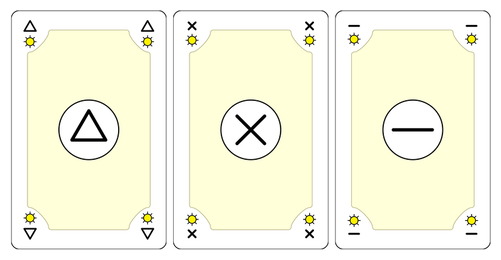
The three zero-point cards needed a category that (1) clearly separates them from the point cards, (2) has names people can actually say, and (3) has an obvious order. Our first attempt used dot counts — single-dot, double-dot, triple-dot. We killed it for two reasons: the names weren't intuitive, and it felt wrong for a symbol that looks like "points" to be worth zero. What shipped instead: Dash, Cross, and Triangle, ranked by how many strokes it takes to draw each one — one, two, three.
We'll admit the Triangle breaks the deck's own rule that every card should be rotationally symmetric around its center point — three parallel strokes would have been symmetric, but nobody agrees on what to call that shape. We chose a name people would actually use over strict geometric purity.
The part we're proudest of
One card. Two rankings. No extra rules.
Null games throw out everything — no trump, and the goal flips to losing every trick — which normally means learning a second, unrelated ranking from scratch. We wanted to avoid that without printing two versions of every card.
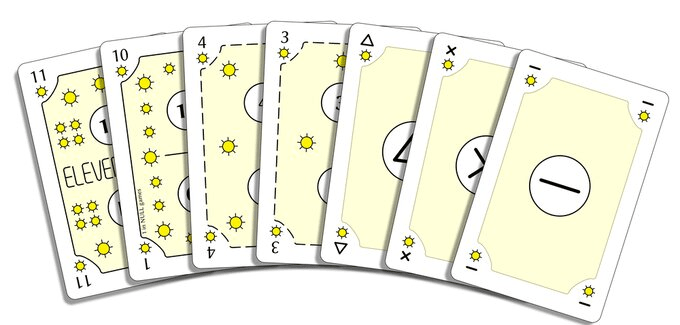
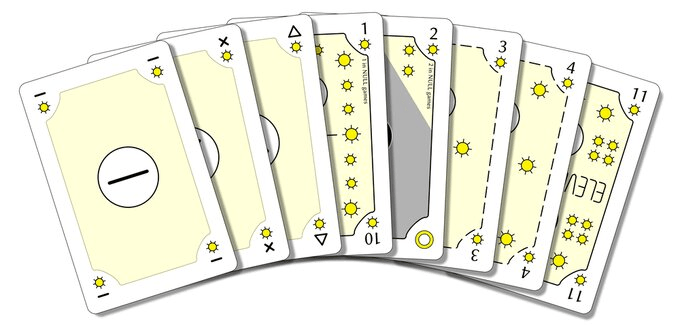
The trick: when you fan a hand of cards, each card mostly shows only one top corner — left or right, depending which way you fan. So we labeled the top-right corner specifically for Null games. Fan your hand one way and you see the Ring-games ranking. Fan the same cards the other way and the top-right corners take over: the Ring card's color corner shows through, reminding you it now counts as its color instead of trump, and the 10 gets demoted to a small "1." The full Null order — Dash, Cross, Triangle, 1, 2, 3, 4, 11 — falls out exactly in step with the numbers now showing. No second deck, no lookup card, no memorizing. Just which direction you happen to be holding your hand.
Why write any of this down
Anyone can print a deck in nicer colors. What's harder to fake is actually thinking it through — trying an idea, finding the flaw, trying again. We could have left out every rejected idea above and just shown you the version that shipped. We think showing the ones that didn't work, and why, says more about whether this deck was actually designed than any amount of marketing copy could.
This write-up predates the Kickstarter campaign by a few months — it's close to the original, unedited reasoning, written down while the ideas were still fresh.