Learn to play
How to Play Skat
Skat is Germany's national card game: a 3-player trick-taking game that's been played for over 200 years and was declared an Intangible Cultural Heritage by UNESCO in 2016. It has a reputation for depth — and, in English, for rules that are hard to find explained clearly. This page is the complete rules, the four things that trip up every beginner, a worked scoring example followed start to finish, and full video walkthroughs. Read it once and you can play tonight.
Last updated 2026-09-14
Skat in 60 seconds
Skat is a trick-taking game for three players, played with 32 cards. Before play starts, the three of you hold an auction, and whoever bids highest becomes the solo player for that hand — playing alone against the other two, who team up as defenders. There are 120 card points in the deck; the lone player needs 61 of them to win. The four Jacks are always trump, and in most games so is one suit that the lone player names. Two cards — the Skat, the game is named after — sit face down on the table, and the lone player usually gets to pick them up and throw two cards back. That's the whole game. Everything below is the detail that makes it work.
What you need
- Three players. (Four or five can sit at the table — see below.)
- 32 cards. A dedicated Skat deck works out of the box. A standard 52-card poker deck works too — just strip out the 2s through 6s, leaving Ace, 10, King, Queen, Jack, 9, 8, 7 in each suit. See our guide to playing with a standard deck for a printable reference.
- A way to keep score. Paper and pencil is traditional; a phone note works fine.
The four things that confuse every beginner
Everything else about Skat is ordinary trick-taking. These four are the actual wall new players hit — and once they click, the rest of the game is easy.
The Jack of Hearts is not a Heart
In Skat, the four Jacks leave their suits entirely. They aren't Hearts or Spades any more — they form their own group, and in Suit and Grand games that group is always trump. (Null games are the one exception: no trump at all, not even the Jacks — more on that under "Choosing your game" below.)
They rank Clubs, Spades, Hearts, Diamonds, strongest to weakest. There's no reason you'd work that out from the cards themselves; it's just the order everyone learns.
What it means at the table: if someone leads a Heart, the Jack of Hearts does not follow suit. Playing it is trumping. And if Hearts are trump, the trump suit is eleven cards, not eight: the four Jacks first, then A, 10, K, Q, 9, 8, 7 of Hearts.
This is the first thing the Blue Rings deck fixes: the Jacks are printed as Ring cards with one to four rings, so the order is on the card. But the rule is the same whatever deck you use — including a standard one, which is exactly where this confusion bites hardest. See our standard-deck guide.
A 10 beats a King
Card ranking in Skat follows card points, not the order you know from other games. Within a plain suit the order is A, 10, K, Q, 9, 8, 7 — the Ten sits second, above the King and Queen.
It stops being strange once you see the point values, because the ranking is just the point values in order:
| Card | Points |
|---|---|
| Ace | 11 |
| Ten | 10 |
| King | 4 |
| Queen | 3 |
| Jack | 2 |
| 9, 8, 7 | 0 |
That's 120 points in the deck (4 suits × 30 points each). The lone player needs 61 to win — one more than half. Take 90 or more and you've won Schneider; take every trick and you've won Schwarz.
Note that the Jacks are worth only 2 points each even though they're the strongest cards in the game. Power and points are separate things in Skat, and that gap is most of what makes the game interesting.
This same A-10-K-Q-9-8-7 point ranking runs through a whole family of German trick-taking games, not just Skat — Schafkopf, Doppelkopf, and Sheepshead (big in Wisconsin taverns) all use it too, with different trump rules layered on top. Learn it once and you can read the cards in any of them.
Points and tricks are different things
It's easy to assume winning more tricks means winning the hand. It doesn't — only the 120 card points matter, and they're spread unevenly. A trick made of three low cards (9s, 8s, 7s) can be worth 0 points; a trick with an Ace and a Ten in it is worth 21 points on its own. Winning six small tricks and losing four big ones can easily lose you the hand. Count points, not tricks won.
The bid is a promise, not an offer
Bidding in Skat isn't an auction for the right to try — it's a running promise. A bid of, say, 24 doesn't mean "I'll play if nobody outbids me for around 24 points of value." It means "the game I end up playing will genuinely be worth at least 24, or I lose automatically, whether or not I take enough card points to have won otherwise." Bid higher than what your actual hand ends up being worth and you lose the moment play ends, no matter how the tricks fell. This is why new players are told to bid conservatively — see Skat bidding, explained for the full logic.
The cards, ranked
In Suit and Grand games, trump always ranks the same way, and the plain (non-trump) suits each rank the same way as each other. Null games throw both of those out — see the third ladder below.
On the Blue Rings deck the four Jacks are the Ring cards, ranked Blue > Green > Red > Yellow — same order, printed on the cards instead of memorized.
Dealing
The deal goes 3 – (2 to the Skat) – 4 – 3: three cards to each player, two face-down to the Skat, four more to each player, then three more to each player. Everyone ends up with 10 cards; the Skat holds 2.
The player to the dealer's left is forehand (leads first, and gets first say in bidding); next is middlehand; the dealer is rearhand. The deal rotates left each hand.
Bidding, the short version
It isn't a back-and-forth of both sides naming numbers — one side calls out ascending numbers, and the other just answers yes or pass to each one. Middlehand calls first, with forehand answering; whoever's left standing then calls against rearhand (the dealer), who answers the same way. Whoever's left after both rounds becomes the solo player and plays alone against the other two.
The classic memory aid for the whole sequence: Deal, Listen, Bid, Bid more(Geben, Hören, Sagen, Weitersagen) — at any moment you're either listening and answering, or bidding and waiting to hear back.
The numbers (18, 20, 22, 23, 24, 27, 30…) aren't arbitrary — each one is a game value your hand needs to be able to reach. If you don't know whether your hand supports a number, the safe beginner rule is: bid 18, or pass. Overbidding loses the hand automatically (see "the bid is a promise" above), and new players overbid constantly.
This is the compressed version. For the full mechanics — why the numbers are what they are, how to count what your hand supports, worked bidding examples — see Skat bidding, explained.
Choosing your game
After winning the bid, the solo player usually picks up the Skat, looks at all 12 cards, discards 2 face down, and announces what they're playing:
| Game | Trump | To win |
|---|---|---|
| Suit | 4 Jacks + one chosen suit (11 cards) | 61+ of 120 points |
| Grand | 4 Jacks only | 61+ of 120 points |
| Null | None at all | Lose every single trick |
| Hand | (modifier, any game above) | Play without ever touching the Skat — higher risk, higher value |
Grand is harder than a suit game (only 4 trumps instead of 11) and worth more as a result. Null flips the goal entirely — you're trying to lose, and a single high card falling the wrong way ends the hand.
Playing the hand
Forehand leads any card. Going clockwise, each other player must follow suit — play a card of the suit led — if they have one. If you're out of that suit, you may play trump (which wins unless someone else trumps higher) or discard anything else.
Whoever plays the highest trump wins the trick; if nobody trumps, the highest card of the suit led wins. The winner leads the next trick. After 10 tricks, every card in the deck has been played — add up the points in the tricks the solo player won.
Scoring, with one worked example
This is the part every other Skat page skips. Here's one hand, followed all the way from deal to final score.
Deal. Charlie deals. Alice is forehand.
Bid. Alice bids Bob and Charlie down, winning the auction at 20.
Contract. Alice picks up the Skat, discards two cards, and announces Clubs as trump — a suit game.
Hand. Alice's 10 cards include the Jack of Clubs, Jack of Spades, and Jack of Hearts, but not the Jack of Diamonds. That's three trumps held in unbroken sequence from the top — "with 3" (mit 3).
Play. Over the ten tricks, Alice's cards capture 72 of the 120 card points — comfortably clear of the 61 she needed, though short of the 90 for Schneider.
Game value. Clubs has a base value of 12. The multiplier is the matador count plus one for the game itself: 3 + 1 = 4. Value = 12 × 4 =48.
Score. 48 is well above the 20 Alice bid, so her promise is kept. She scores +48. If she'd taken fewer than 61 points, she would have scored −48 instead — the value doesn't change, only the sign.
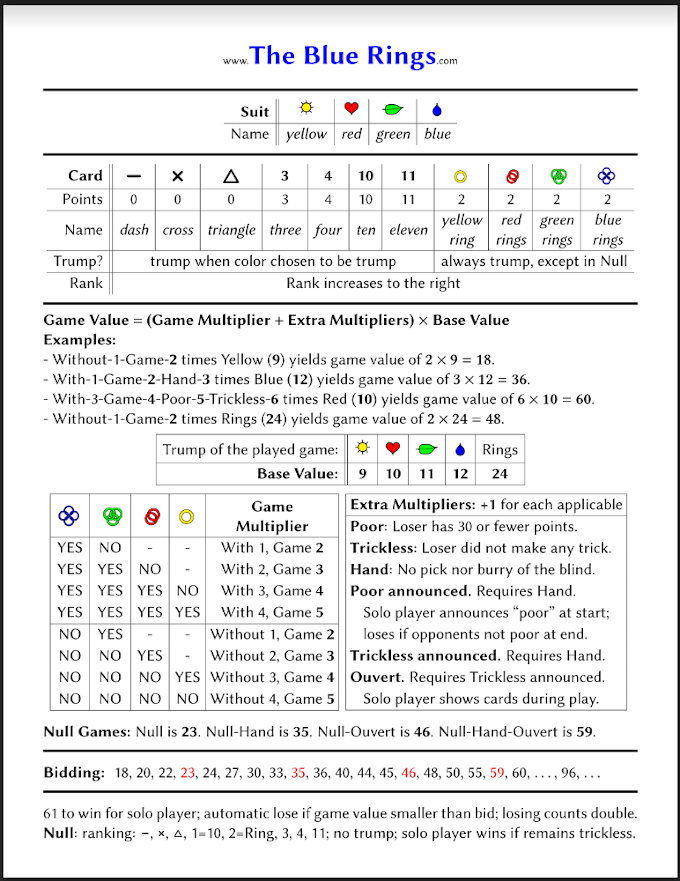
Hand, Schneider, and Schwarz each add their own +1 to that multiplier when they apply — see the Game Values video below, and the deck's own Game Values reference card, for the full formula with those bonuses included. Or skip the arithmetic: the game value calculator does it for any hand, including Hand, Schneider, and Schwarz.
When everyone passes (Ramsch)
Officially, if all three players pass without a bid, the hand is simply skipped and the next dealer deals fresh — nobody plays it out. In practice, most tables play Ramsch instead: no trump suit is named up front (Jacks are still trump, in their usual order), there's no solo player, and everyone plays for themselves, trying to take as few card points as possible instead of as many. Whoever's left holding the most points at the end loses. It's worth agreeing with your table which of the two you're playing before you start.
Ramsch is one of a handful of German terms you'll run into — see the full glossary for the rest, with pronunciation.
Four- and five-player tables
Skat is a 3-player game, but tables of four or five are completely normal — extra players just take turns sitting out. With four, the dealer sits out that hand and deals again next time it's their turn a round later. With five, two players sit out each hand. Either way, the deal (and the sitting-out) rotates so everyone plays roughly the same number of hands over an evening.
Your first evening: a 20-minute plan
Don't start with bidding. It's the part that takes an evening to get comfortable with, and it isn't needed to learn how the cards behave.
Deals 1–3: open hands, no auction. Everyone puts their cards face up. Pick someone to be the lone player and name a trump suit. Play the hand out and count the points. Talk through the tricks as you go. Three deals is usually enough for everyone to see how the Jacks work.
Deals 4–6: closed hands, still no auction. Take turns being the lone player, going around the table. Keep a cheat sheet at every seat.
Deal 7 onward: add the auction. Start everyone at 18 — the lowest legal bid. If you aren't sure whether you can make it, pass. Overbidding costs you the hand automatically, and new players overbid constantly.
An evening like that gets three people from nothing to a real game. It's roughly how we've taught it for years, and where the deck came from.
Watch: English
After the first video, Game Play, you can start playing. Come back for the other two when you're ready for the more technical parts — how game values are calculated, and how bidding works.
“Phenomenal video — this really makes it super easy to learn the game.”
Auf Deutsch
Nachdem man das erste Video, Das Stichspiel, gesehen hat, kann man schon spielen. Komm hierher zurück, um die anderen beiden Videos zu sehen und zu lernen, wie man Spielwerte berechnet und wie das Reizen geht.
Print your own cheat sheet
A free, printable letter-sized reference sheet covering card ranks, points, and Null game rules.
Own a standard deck? Start with the standard-deck cheat sheet — it's in Clubs, Spades, Hearts, and Diamonds. Already have the Blue Rings deck? The Blue Rings cheat sheet matches your cards directly. Sorting out how bidding actually works? See Skat bidding, explained.
Frequently asked questions
How many players do you need for Skat?
Three play each hand. Four or five can sit at the table and rotate — see "Four- and five-player tables" below.
How many cards are in a Skat deck?
32 — Ace, 10, King, Queen, Jack, 9, 8, and 7 in each of four suits. If you're starting from a standard 52-card poker deck, strip out the 2s through 6s.
Can I play Skat with a normal deck of cards?
Yes. Strip the 2s through 6s from a standard 52-card deck and you have the 32 cards Skat needs. It works completely, though it makes the "the Jack of Hearts is not a Heart" adjustment (below) a bit more work, since there's no visual cue on the cards themselves — see our standard-deck guide for a printable reference.
Why is the Jack of Hearts trump?
In Suit and Grand games, all four Jacks leave their suits and become their own permanent trump suit, ranked Clubs, Spades, Hearts, Diamonds from strongest to weakest. It's not a Hearts card once it's a trump card. (Null games are the exception — no trump at all.) See "The Jack of Hearts is not a Heart" above.
Why does a 10 beat a King?
Card ranking in Skat follows card points, not the face-value order you know from other games. Within a suit, the order is A, 10, K, Q, 9, 8, 7 — see "A 10 beats a King" above.
How many points do you need to win a hand of Skat?
61 of the 120 total card points. Get 90 or more and you've won with Schneider; take every trick and you've won Schwarz.
What is Schneider? What is Schwarz?
Schneider means winning (or losing) with 90 or more of the 120 card points — a bigger margin than a plain win. Schwarz means winning (or losing) every single trick. Both add multipliers to the game value.
What happens when everybody passes?
Officially, the hand is skipped and redealt. In practice, most tables play Ramsch instead, where everyone tries to take as few card points as possible. Agree on which your table uses before you start.
How long does a game of Skat take?
One hand is 5–10 minutes once you know what you're doing. A full session is usually 24 or more hands (so everyone deals the same number of times), which runs a couple of hours.
Is Skat harder than Bridge?
Different, not harder. There's no partner to communicate with, so the bidding is closer to arithmetic than convention — you're estimating your own hand's value, not signaling. Most people find the play itself easier to pick up than Bridge and the bidding easier than it looks.
Ready to play?
The game works with any deck — this one just removes the four confusions above, with the Jack order and card points printed right on the cards.
Get the Deck — $13